
Ali

Your Career Gap Analysis: How to Diagnose Exactly Why You’re Not Getting Interviews?

You send out application after application. You tweak your CV a little. You write a new cover letter. You hit submit. And then… nothing. No email. No phone call. Just silence. After a while, you start asking yourself the same questions over and over. Is my CV bad? Am I not qualified? Is something wrong with me? Why is everyone else getting interviews but me? Here is the truth. You are not alone. This happens to thousands of job seekers every single day. And most of the time, it is not because you are “not good enough.” It is because you are missing something simple. A gap. A disconnect between what you are offering and what employers actually want. The problem is, you cannot fix what you cannot see. That is where career gap analysis comes in. Think of it like going to a doctor. You do not just say “I feel sick” and hope to get better. You describe your symptoms. The doctor runs tests. They find out exactly what is wrong. Then they give you the right medicine. Your job search needs the same approach. Stop guessing. Start diagnosing. Step 1: Stop and Look at Your Process Honestly Before we dig into gaps, let us look at how you are applying right now. Be honest with yourself. Ask these simple questions: If you answered “no” to some of these, do not feel bad. Most job seekers do the same thing. We get tired. We get desperate. We start spraying applications everywhere hoping one will stick. But here is the hard truth. Spraying and praying does not work. It just leads to more silence and more frustration. The first step in gap analysis is admitting that your process might have gaps, not just your skills. Step 2: Check Your Role Fit (Are You Applying to the Right Jobs?) Here is a tough question. Are you applying to jobs you actually qualify for? I am not asking if you want the job. I am asking if your background, experience, and skills match what the employer listed as “required.” Many job seekers apply to jobs where they only meet half the requirements. They think “maybe they will train me” or “I can learn on the job.” Sometimes that works. Most of the time, it does not. Do a quick role fit check on your last five applications: If you are missing more than one or two required items, that job was probably a long shot. And every long shot you take is time and energy you could have spent on jobs where you are a real contender. The gap: You might be wasting applications on jobs that were never a good fit from the start. Step 3: Check Your CV Targeting (Does Your CV Speak Their Language?) Imagine you are looking for a mechanic who knows how to fix Toyota cars. Someone gives you a CV that talks all about fixing motorcycles. Would you call them? Probably not. Even though both work on vehicles, the specific match is not there. Employers think the same way. They have a problem to solve. They need someone with specific skills. They scan CVs looking for their language. Do a CV targeting check: If your CV uses different language than the job description, the recruiter might scan right past it without realizing you are a match. You have the skills, but you did not show them in a way they recognize. The gap: Your CV might not be speaking the employer’s language, even if you are qualified. Step 4: Check Your Skill Gaps (What Are You Missing?) This is the big one. And it is the hardest to see on your own. Sometimes we think we are ready for a job, but we are missing key skills that employers care about. Not just technical skills like software or machines. Soft skills too. Communication. Problem solving. Working with others. The tricky part is, employers rarely tell you what you are missing. They just do not call. Do a skill gap check: For example, a job might ask for “strong communication skills.” You might think “I talk to people every day, so yes.” But maybe they mean writing professional reports. Or giving presentations to clients. Or handling difficult conversations. “Communication” can mean many different things. The gap: You might be missing specific skills that employers expect, and you do not even know it. Step 5: The “Readiness Score” Concept Now let me introduce you to a simple idea that changes everything. Imagine if you could get a score that tells you, clearly and honestly, how ready you are for the job market. Not a guess. Not your friend’s opinion. A real score based on real checking. This score would look at: This is what we call a readiness score. It is like a report card for your job search. It does not judge you. It just shows you where you stand and what to work on. Think about how useful that would be. Instead of guessing why you are not getting interviews, you would have clear answers. Instead of feeling lost, you would have a roadmap. Your Personal Gap Analysis Checklist Here is a simple checklist you can use right now to start your own diagnosis. Go through each question and answer honestly. About Your Applications: About Your CV: About Your Skills: If you checked “no” to any of these, you have found a gap. Good. Now you know what to work on. The Problem with Self-Diagnosis Here is the honest truth. Doing this checklist yourself is helpful. But it is also limited. Why? Because you are judging yourself. And we are all bad at judging ourselves. We either think we are better than we really are, or we think we are worse. We have blind spots. Things we cannot see because we are too close to them. This is exactly why at TLTD TryMe, we built tools that give you an outside view. Our Basic Requirements Test is a quick check that tells you if you meet the

Your Career Gap Analysis: How to Diagnose Exactly Why You’re Not Getting Interviews? Read More »

The 4 Soft Skills Middle Eastern Employers Are Desperate For in 2026

Let us be honest about something. A degree gets your foot in the door. But it does not keep you in the room. For a long time, job seekers in the Middle East believed that a university certificate was the golden ticket. Get the degree, get the job. Simple. Not anymore. Employers across the Gulf, Iraq, Jordan, Egypt, and Lebanon are changing what they look for. They still want to see your education. But now, they are desperate for something else. Something your degree does not show. They want soft skills. These are not technical things like coding or accounting. These are people skills. Thinking skills. Work habits. And in 2026, the candidates who have these skills will get hired first, paid more, and promoted faster. I have talked to hiring managers in Dubai, Riyadh, Baghdad, and Cairo. I asked them: “What do you need most right now that is hard to find?” Their answers kept coming back to four things. Let me share them with you. Soft Skill #1: Bilingual Communication The Middle East workplace is unique. You might have an email in English from a client in London, then a phone call in Arabic with a supplier in Saudi, then a meeting where both languages mix together. Employers are desperate for people who can switch smoothly between languages without getting stuck. What this looks like at work: A real example:A marketing manager in Dubai told me about two candidates for a job. Both had good degrees. One spoke English well and Arabic okay. The other could write reports in English, present to clients in Arabic, and translate quickly between both during meetings. The second person got the job and a higher salary. Why? Because they saved the company time and avoided misunderstandings every single day. The simple truth: If you can only work well in one language, you limit yourself. If you can handle both with confidence, you become essential. Soft Skill #2: Adaptability and Agile Problem-Solving Things in business change fast. A client changes their mind. A supplier runs late. A new rule comes from the government. A global problem disrupts shipping. Employers are tired of people who freeze when things go wrong. They want people who can think on their feet and fix problems fast. What this looks like at work: A real example:A logistics company in Iraq had a shipment stuck at the border because of a paperwork problem. The junior coordinator did not wait for the manager to fix it. She called the customs office, found out what document was missing, contacted the client to get it, and emailed it over. The shipment moved in one day instead of one week. Her manager noticed. Within six months, she was promoted. The simple truth: In 2026, companies move fast. They need people who can keep up and solve problems without hand-holding. Soft Skill #3: Cross-Cultural Teamwork Look around any office in the Middle East today. You will see people from different countries, different backgrounds, and different ways of working. You might have a Jordanian manager, an Egyptian engineer, a Filipino assistant, an Indian developer, and a Saudi client all working together. This is normal now. Employers need people who can work well with anyone, no matter where they come from. What this looks like at work: A real example:A construction company in Qatar had a team with workers from Nepal, India, Egypt, and the Philippines. The site supervisor who succeeded was not the one who yelled the loudest. It was the one who learned a few words in each language, respected prayer times for Muslims, understood different holiday traditions, and treated everyone with dignity. His team finished projects faster with fewer problems. The simple truth: Companies in the Middle East are small versions of the whole world. If you cannot work with everyone, you cannot work here. Soft Skill #4: Taking Initiative and Being Self-Starter Here is a question employers ask silently when they look at candidates: “Will this person wait to be told what to do, or will they find things that need doing and do them?” The people who wait for instructions are easy to find. The people who take initiative are rare and valuable. What this looks like at work: A real example:A small tech company in Amman had a junior employee who noticed their social media posts were getting very few likes. She did not wait for the marketing manager to ask. She spent a weekend learning some basics about better posting times and better content. On Monday, she showed her manager a simple plan to improve. The manager was impressed. Within a year, she was running the company’s social media alone. The simple truth: Managers are busy. They do not have time to tell everyone every little thing to do. They want people who can think for themselves and just get things done. The Quick Checklist: Do You Have These Skills? Ask yourself honestly: If you answered “yes” to most of these, you are on the right track. If you answered “not yet” to some, do not worry. These are skills you can build. How Do You Know If You Really Have These Skills? Here is the challenge. Your degree does not prove you have soft skills. Your CV does not prove it either. Anyone can write “team player” or “good communicator” on paper. So how do you know where you really stand? This is exactly why we built the Skills Assessment Test at TLTD TryMe. It is not about your degree or your work history. It is about checking your actual abilities today. The test evaluates: When you finish, you get a clear breakdown. You see your strengths. You see your gaps. And you get simple, practical steps to improve. No guessing. No hoping. Just clear answers about where you stand. Your Next Step The job market in the Middle East for 2026 will reward people who have more than just a degree. It will reward people who can communicate across languages, solve problems fast, work with anyone, and take charge

The 4 Soft Skills Middle Eastern Employers Are Desperate For in 2026 Read More »

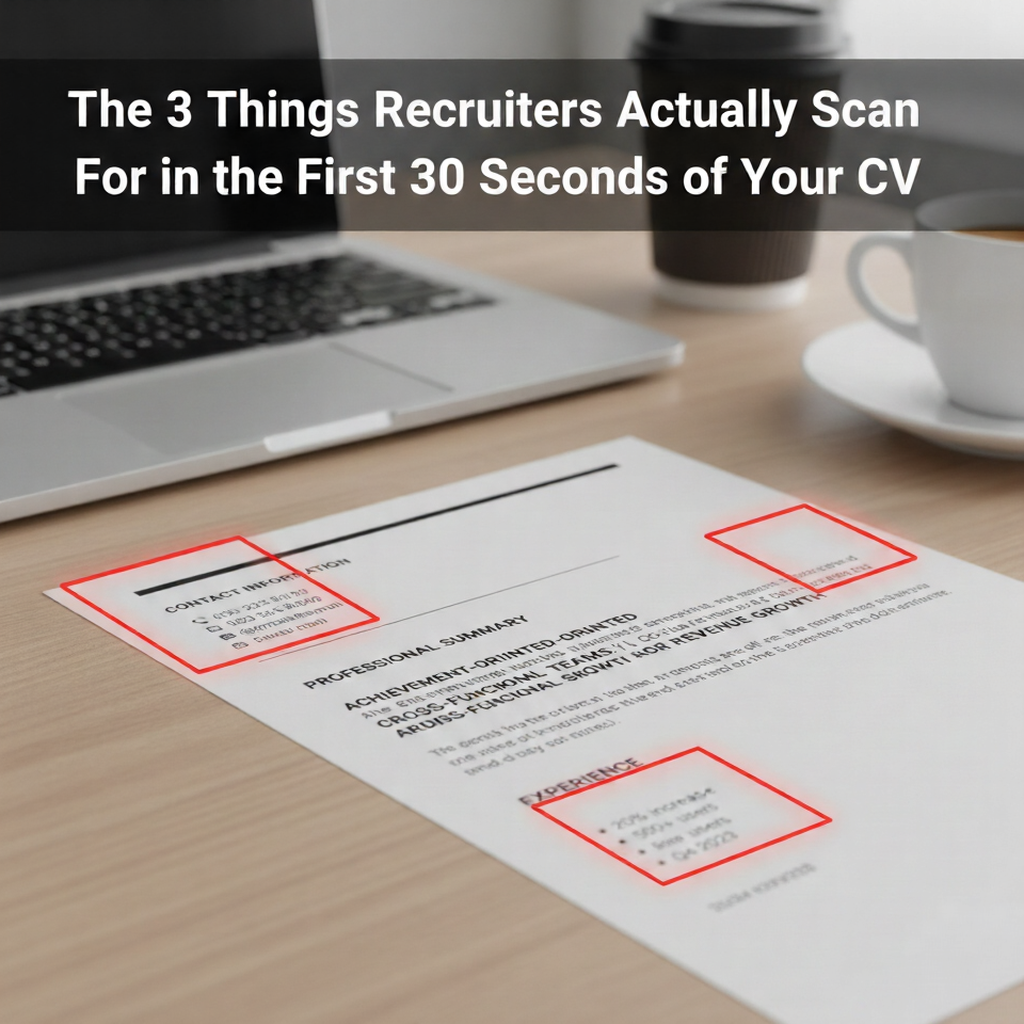
The 3 Things Recruiters Actually Scan For in the First 30 Seconds of Your CV

You spend hours crafting your CV. You tweak the fonts, adjust the margins, and carefully list every job you have ever had. You hit send and hope for the best. But here is something you might not know. Most recruiters will spend less than 30 seconds looking at your CV for the first time. Sometimes even less. In those few seconds, we decide if your application goes into the “yes, let’s talk more” pile or the “no, next” pile. So, what are we actually looking for in that quick scan? What makes us stop and read more? I have been on the recruiting side for so many years. Let me pull back the curtain and share the three things every recruiter checks in the first 30 seconds of looking at your CV. Use this knowledge to make your CV pass the quick scan every time. Thing #1: The Quick Fit Check (Do You Have What We Asked For?) When a recruiter opens your CV, we have the job description open in another tab or fresh in our mind. We are not reading your life story. We are matching. In the first few seconds, our eyes go straight to a few key spots looking for specific things: Your job titles. Do they match what we are hiring for? If we need a “Project Manager” and you were a “Project Coordinator,” that is close. If you were a “Barista,” we have to dig much deeper to see the connection. Make it easy for us. Use titles that clearly show what you did. Your dates. We check for gaps. Not to judge you harshly, but to understand your story. Did you leave a job in 2020 and start one in 2022? We notice. Be ready to explain that gap simply in an interview. Also, we check if you job hop every six months. That raises questions about stability. Your education and certificates. Did the job ask for a university degree or a specific license? Our eyes scan for those keywords right away. If you have it, great. If not, we look for experience that might replace it. The simple truth: If you pass this quick fit check in the first 10 seconds, we keep reading. If not, your CV goes into the “maybe later” pile, which usually means never. Thing #2: Proof, Not Just Duties (Did You Actually Do Anything?) This is where most CVs fail. Let me show you the difference. The weak way (just listing duties): The strong way (showing proof): Do you see the difference? The second one gives proof. It uses numbers, results, and specific outcomes. In those 30 seconds, our eyes are searching for: When we see a CV full of duties (“responsible for,” “worked on,” “helped with”), we assume you just showed up and did the minimum. When we see results, we see someone who makes things happen. Thing #3: Clarity and Easy Reading (Can We Find Things Fast?) Recruiters are tired. We have been looking at CVs all day. We have coffee nearby and a long list of candidates to get through. If your CV is hard to read, we will not struggle through it. We will move to the next one. Here is what makes a CV easy to scan in seconds: Clean layout. Use clear headings like “Work Experience,” “Education,” and “Skills.” Leave white space. Do not cram everything into tiny text with no breaks. Bullet points, not paragraphs. Big blocks of text are hard to scan. Bullet points let our eyes jump to the important parts quickly. Consistent formatting. Make sure all your dates line up on the page. Use the same font size for similar items. If your CV looks messy, we assume you do not pay attention to details. Contact info at the top. Your name, phone, email, and location should be the first thing we see. Do not make us hunt for how to call you. Your 30-Second CV Checklist Before you send your next application, run through this quick checklist. Ask yourself: If you answered “no” to any of these, your CV needs work before you send it out again. But Here Is the Deeper Truth A clean CV with good numbers will get you in the door. But here is something many job seekers miss. Your CV is just a piece of paper. It says what you did. It does not prove what you can actually do. Recruiters have been fooled before. A beautiful CV arrives. The person looks perfect on paper. Then comes the interview or the first day on the job, and it turns out they cannot actually communicate well, work with a team, or solve basic problems. That is why smart recruiters are looking beyond the CV. They want to know: does this person actually have the skills? Your CV gets you the interview. But your real skills get you the job. This is exactly why at TLTD TryMe, we built the Skills Assessment Test. Your CV shows your history. Our assessment shows your current ability. It evaluates your communication skills—reading, writing, speaking, listening. It checks your core soft skills that employers care about most. When you take the Skills Assessment, you get a clear breakdown of where you truly stand. No guessing. No hoping. You know your real level, and you get personalized steps to improve. Imagine going into an interview not just with a good CV, but with proof of your actual skills. That is power. Your Next Step Start by fixing your CV using the checklist above. Make it pass the 30-second scan. Then, go deeper. Find out if your skills match what your CV claims. [Take the Skills Assessment Test today] and get a complete breakdown of your communication and soft skills. Know your true strengths. Find your real gaps. Walk into your next interview with confidence, not just hope. Because in today’s job market, the people who win are not the ones with the fanciest CVs. They are the ones with the real skills to back it up.

The 3 Things Recruiters Actually Scan For in the First 30 Seconds of Your CV Read More »

Apply and Pray

Why Sending 100 CVs is the Worst Job Search Strategy And What to Do Instead? If you’re looking for a job, you’ve probably heard this advice: “Just apply to as many jobs as possible. It’s a numbers game.” So, you spend nights and weekends searching, clicking, and sending out your CV. 10 applications. 50. Maybe even 100. You wait, hoping that this time, the phone will ring. But for most people, it doesn’t. Silence. Or worse, a flood of automated rejection emails that say nothing about why. This exhausting cycle has a name. We call it the “Apply and Pray” Trap. You apply, then you pray for a response. It’s the most common—and most flawed—job search strategy today. Let’s break down why this approach is setting you up for failure and, more importantly, what you can do instead to take back control of your job search. Why the “Apply and Pray” Method Is Broken It might feel productive to send dozens of applications, but this method is broken for a few simple reasons: 1. You Become a “Maybe,” Not a “Must-Hire.” When you apply for a job where you only match 60% of the requirements, what does the recruiter see? Gaps. Your application goes into the “maybe” pile, which is often the same as the “no” pile. Hiring managers are looking for reasons to say yes quickly, not reasons to dig deeper. 2. You Burn Out Before You Even Start. Job searching is emotionally draining. Each application takes energy and hope. Getting rejected 100 times—or hearing nothing 100 times—is crushing. This burnout kills your confidence, making you perform worse in interviews when you finally get one. 3. You Learn Nothing. Getting a generic rejection email teaches you nothing. Why didn’t you get an interview? Was it your CV? A missing skill? The wrong keywords? Without feedback, you can’t improve. You just repeat the same process, expecting different results. 4. You Miss the Jobs You Are Perfect For. While you’re busy applying to 100 unsuitable jobs, you’re spending less time crafting an amazing application for the 5 jobs you are truly perfect for. You become a “mass applicant,” not a “standout candidate.” The Smarter Alternative: Apply Strategically, Not Desperately The solution isn’t to work harder at the wrong strategy. It’s to change your strategy completely. Stop applying first. Start understanding your true job market readiness first. This is a simple, three-step shift in mindset: This is how you escape the trap. Let’s see what this looks like in practice. Step 1: The Reality Check (Test Before You Invest) Before you spend an hour applying for a job, spend 5 minutes asking: “Am I genuinely ready for this role?” This isn’t about guessing. It’s about checking the facts. Just like you wouldn’t run a marathon without checking if you can finish 5K, you shouldn’t apply for a job without checking if you meet the basic requirements. What to do: Step 2: From Guesswork to Gap Analysis (Understand Your “Why”) Once you know your score, the magic is in the “why.” Strategic job searching is about diagnosis. If your CV isn’t getting responses, you need to know the specific reason: What to do: Step 3: The Precision Apply (Target Your Best-Fit Roles) Now, armed with clarity, you change how you apply. Instead of searching for any job, you search for the right job. You only invest serious time applying for roles where: What to do (Coming Soon): Your Action Plan to Escape the Trap Today You don’t have to stay stuck in the “Apply and Pray” cycle. You can start applying strategically right now. The job market isn’t just a numbers game. It’s a fit game. Your goal isn’t to apply for the most jobs; it’s to be the most prepared, well-matched candidate for the right job. Stop applying and praying. Start knowing and growing. Ready to break the cycle? Discover your true job-readiness score and see exactly where you’re losing opportunities—before you send another application. Your Free Assessment Awaits.  

Apply and Pray Read More »

Scroll to Top